




The Oba’s royal palace:
Anyone who knows the Kingdom properly knows that the palace is regarded as one of the greatest museums in the world because it still holds a large collection of royal court arts, scriptural pieces of past Obas in bronze and ivory and ancestral shrines
{4th} Oba Ewedo {About 1255AD-1280AD} Concerned about been in the midst of the powerful and sometime roughly Edionisen {the five elders} of the kingdom, he called them {people who have no respect for their monarch} ''Emwan nei zama omwan'' corrupted to Uzama. Oba Ewedo reduce the power and influent of the Uzamas, created other groups of royal chiefs to counter balanced their power, moved the royal palace, the seat of government of the kingdom from Usama {a village outside Benin city} to it present place in Benin City the heart of the kingdom. To avoid power struggle. {12th} Oba Ewuare the Great {About 1440AD-1473AD} added his first son to Uzama group to make them six. Chief Ezomo rejoined the group during the reign of {28th} Oba Akenzua I {About 1713AD-1735AD} to make them seven. To this day the group are called Uzama Nihinron {seven kingmakers}. All first son of subsequent Obas are members of Uzama Nihinron along- side the position of Edaiken of Uselu and the hair to the throne. This ancient royal palaces is centrally located near the king square in Benin City. It attracts alot of visitors all year round. The present palaces was rebuilt after the 1897 infamous British punitive expedition, which destroyed the former palace. In 1999, UNESCO listed the Oba's palace, and Igun Street the citadel of brass casting as cultural heritage site. |
||
times without any break though with discernible chronological stages of development.
In traditional Benin; before the invasions, of Benin Empire, in 1897 by British forces. The Oba controlled the production and the distribution of brass/bronze arts work no single individual have any right to own any of the production process in those days except with the permission of the Oba of Benin. The story is very different today visitors are free to admire, witness bronze casting from the various stages purchase any piece of their choice without let or hindrance. This is probably the most patronized tourist attraction in Benin kingdom/Edo state. |
||
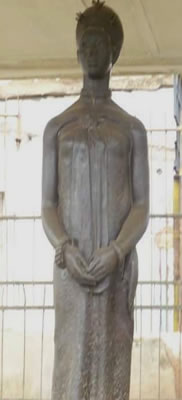
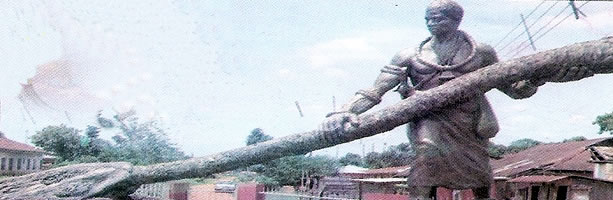
kingdom in place of his senior brother,Prince Ogun who was the heir apparent. Ogun in those times of travail. paid secret and nocturnal visits to Benin from his exile. On many occasions,this market woman called Emotan warmed Ogun of impending dangers and advised him against interacting with some treacherous chiefs who may reveal his presence. On one occasion Emotan actually hide prince ogun from his adversary
When Prince Ogun eventually regained the throne and was subsequently crowned as the real Oba of Benin, he took the name |
||
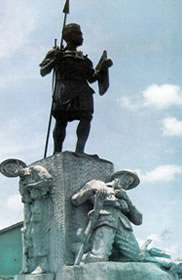
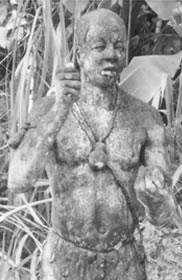
to become SAKPONBA.This statue, which is a salute to patriotism and loyalty is located on the king's Square by the beginning of Sokponba Road,Benin City. The spot where chief Asoro have died after fighting bravely.
|
||
It was declared a National Monument in May 26th 1959 and by Decree 77 of 1979 that establish the National Commission for Museum and monuments; and gazetted under the Federation of Nigeria official gazette No. 31 Vol. 46 of 1959, the protective cover of part II section 3 of the 1999 constitution of the Federal Republic of Nigeria under the concurrent legislative list.
The Chief Ogiamien historical building has survived the hash natural weather and human factors of deterioration till date. A rectangular shape of ancient design, fluted terecotta walls, presently covered by corrugated iron roofing sheets and nails, is a typical; unique traditional Benin architectural work. The building has about twenty rooms embedded in eight separate courtyards. A pitch roofing design constructed to provide an impulvia pattern, which is open to the sky to allow ventilation, sunlight, moonlight and rainfall into the courtyards. Ogiamien personal, family and community shrine and altars are also located within the courtyard and other parts of the building. The floor of each courtyard is designed to provide a sunken level which aid water collection into an underground interconnected drainage system. The building has large open kitchen used for the preparation of chief Ogiamien food and an Egun, graveyard where all past Ogiamien were buried. CULTURAL/RELIGIOUS SIGNIFICANT OF OGIAMIEN ANCIENT BUILDING. An administrative building where He (Evian) rule and gave regulations guiding the entire Benin kingdom; He receives visitors and entertain stranger, even accommodate them when necessary. A traditional healing chamber is built in one of the courtyard as centre for administering healing for both spiritual and physical illness and attack. It’s equally a spiritual consultation centre where oracles, rituals, sacrifices and divination and other form of worship take place. It’s a traditional court room where dispute are settled for family and the entire Benin kingdom. Chief Ogiamien celebrates Igue festival a day before the Benin general Igue festival then making his home a centre of ceremony. A section of the palace serves as graveyard for the burial of all past Ogiamien except the first Ogiamien who was buried in his bed-room, Within area of the grave-yard is a place used for pronouncing curses by young girls who were defiled by men (Ake shrine). TABOOS IN THE OGIAMIEN ANCIENT BUILDING Chief Ogiamien wives do take oath of loyalty at the primordial tree Olode Ikhimwin tree, located in the building. And the most junior wife whose duty is to cook, must be naked by custom to avoid any evil intention. He has a personal temple where his personnel items and regalia are kept. He equally isolates himself when preparing for war or after returning from war in this temple. IMPORTANCE Specifically, Chief Ogiamien ancient edifice, provides an avenue for cultural display, film production, family meeting place and a point where poems, idioms are recited. Folksongs such as lullaby and story-telling (folktales) take place. These act as synthesis that condition social life. The monument has enormous cultural tourist potentials which can fetch revenue for both the local community, family and government in general, if properly harnessed, packaged and marketed. In general, the importance of our Heritage cannot be overemphasised. The greatness or pride of a Nation is tied to the wealth of their heritage. Thus conveys a testimony of the people daily life, to express their creative capacity and present the traces of their History. As a receptive or package of memory, it embodies the symbolic of cultural identities and constitute fundamental references for structuring society. Heritage allows every human being the opportunity of self discovery. It is useful in binding social groups together and bringing cultural communities closer to one another.
Heritage is an instrument of third way process between past, present and future. |
||
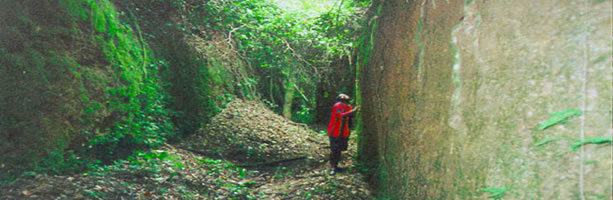
from invaders from Udo about 20 miles from Benin City to the northwest. He further decreed that important towns and Villages should build similar moats as defence systems around their communities. this has given rise to twenty of such moats around Benin City and its environs. An extension of the moat was constructed in the 15th century during the reign of {12th} Oba Ewuare the Great .The Benin moat is over 3200 kilometers long.
|
||
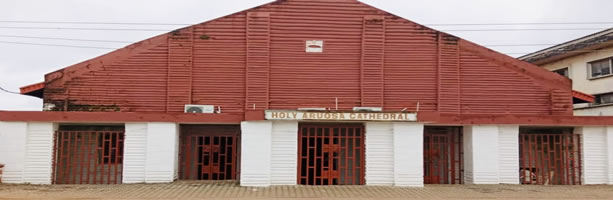
sent from Portugal to establish churches in the kingdom. The remnants of which are Aruosa N'Akpakpava, Aruosa N'Idunwuerie and Aruosa N' Ogbelaka all in Benin City. During the Idah war of 1515-1516 the Portuguese missionaries accompanied Oba Esigie to the battle fields. Oba Esigie could read and write portuguese fluently.
The Benin Monarch is the head of the church, the priests call Ohen-Osa are responsible to him .The pattern of worship is the mixture of indigenous belief and Roman catholic practices.
|
||
which led to the invasion of Benin and the eventual deportation of Oba Ovonramwen to Calabar were he died in 1914.
|
||
took him to Ile-Ife. For full story, see Wikipedia/Benin Empire and The correct history of Benin.An Ideal place for historians, researchers, academicians, students and visitors alike.
The shrine of the Olokun priest who was sent to portugal By Oba Esigie {About1504-1550AD} to understudy christianity and report back to the imperial Benin kingdom is also situated in Ughoton.
|
||
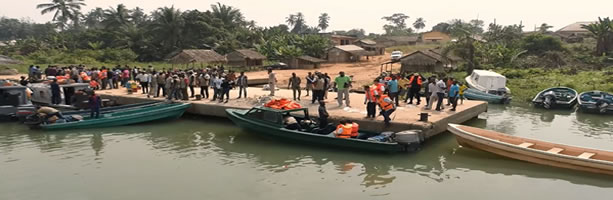
(illegitimate trade) were also conveyed from the region via the Gele Gele Sea Port to Europe. Factually the Portuguese and British Government used the Gele Gele Sea Port extensively for more than half a century before the 1897 infamous British punitive expedition. This historic Sea Port site is today part of Benin kingdom historical sites.
|
||
Benin City. His brother Arhuanran who was tricked from ascending the Benin throne due to palace intrigues, decided to go into battle with the new Oba. The battle was fought and won by Oba Esigie. Arhuanran drowned himself in Lake Odighi N’Udo.
Chief Osemwughe the Iyase of Udo took arm again against the monarchial authority to avenge the defeat and the death of Arhuanran his master cut the victory celebration short. Oba Esigie launch a war on Udo once again .Udo was destroyed chief Osemwughe and his rebel armies fled. West of Benin kingdom now part of Yoruba land. Osemwughe and his militants gave themselves up; when they could not face the war machines of the Binis royal troops much longer. |