|
|
|
Benin Kingdom Historical Sites |
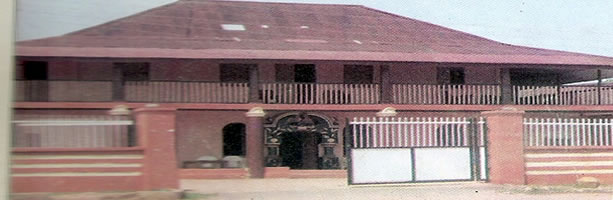
The Oba's Palace:
Anyone who knows the Kingdom properly knows that the palace is regarded as one of the greatest museums in the world because it still holds a large collection of royal court arts, scriptural pieces of past Obas in bronze and ivory and ancestral shrines.
With its unique traditional architecture and works of the arts. First build about 1255 AD by Oba Ewedo. {4th} {about 1255AD-1280AD}, discontented about been in the midst of the powerful and sometime rudely Edionisen {the five elders} of the kingdom, he called them "Emwan nei zama omwan"{people who have no respect for their monarch} corrupted to Uzama. This was not surprising because they brought Oromiyan from Uhe [IIe Ife]. These Edion more or less treated the monarchy as primus inter pares .To avoid more power struggle, Ewedo therefore embarked upon a risky job of supressing the Uzamas and moving the royal palace, the kingdom seat of government from Usama {a village outside Benin city} to its present place in Benin City the heart of the kingdom. Miraculously, he did not only succeed in doing so but eventually surpressed Ogiamien who was virtually in control of the City state. The final settlement came at the battle of "Ekiokpagha" which the Oba fought with Ogiamien who was defeated, after the victory. Oba Ewedo received the royal stool from Ogiamen and builds the present royal palace.
This ancient royal palace is centrally located near the king's square in Benin City. Rebuilt by Oba Eweka II {1914AD-1932AD} after the 1897 infamous British punitive expedition destroyed the former palace.
In 1999, UNESCO listed the Oba's palace, and Igun Street the citadel of brass casting as cultural heritage site.
8 Things Visitors Are Forbidden To Do At Oba Of Benin Palace
The royal house of Benin is one of the most famous in Africa and the world at large. Yearly, tourists and visitors troop to the ancient city located in Edo state, Nigeria to see the palace which holds the rich history of ancient royalty.
Although not all are granted audience with the Oba – Omo N’Oba N’Edo, quite a number of people is allowed to tour specific areas of the Palace. While paying a visit, it is important to check with your tour guide for regulations which govern movements around the palace.
However, if you are set to visit Benin City in a bid to tour the Oba’s Palace alone, visitors are encouraged not to do the following; at the Oba’s palace.
Pointing:
Pointing fingers at either Oba or his chiefs are not allowed at the Oba’s palace. The Oba himself does not point fingers at anyone as well, except in a bid to bless or curse another individual.
Pointing is seen as an act with deep spiritual meaning and so, anyone who does this is promptly arrested by the security guards of the palace known as the Ifienwenro for questioning and possible punishment. The Ifienwenro is a ‘spiritual’ guard whose major duty is to wade off spiritual attack against the Oba. These guards are usually clad in brown wrapper skirts with armlets around them. After arrest, the offender is usually compelled to take an oath before confessing or giving explanations for pointing fingers at the Oba. In dire cases, the offender might be asked to present certain animals for sacrifice.
Whistling:
Whistling might seem like a simple and harmless act, but when in Benin City, especially at the Palace, this is considered rude. Based on superstition, the people of Benin believe whistling to be a medium through which mortals can call to spirits and the dead. The Oba palace houses over 3000 deities and mysticisms with spirits attached to them. It is believed that when a person whistles in the palace, there is no control over which spirit or deity would be roused by the call, and in a situation where the roused spirit does not see any food, offering or appeasement, it might take the life of the whistler or anyone around the vicinity.
Open umbrella during festivals:
Umbrellas are fashioned to offer protection from harsh weather conditions such as rain or sun, however, if you are visiting Benin and you plan to attend a festival, be prepared to stand through any condition the weather throws at you without protection.
During major festivals such as the Igue festival, the Oba of Benin is the only one whose head can be covered with an umbrella. The palace chiefs are expected to leave their umbrellas at the palace gate during festivals. For tourists and visitors who have no prior knowledge of this rule, the security guards known as the Ifiento issue a warning at the entrance.
Black apparel:
Black as a colour typifies mourning in many cultures. Seeing as it is a taboo for the Oba to mourn, no matter the circumstance, he is not allowed to set eyes on the colour black. As a result, anyone wearing black attire is not allowed entrance into the palace, especially if the person has the intention of gaining an audience with the Oba or there is a high chance of the person crossing paths with the Oba.
Women at the Alaka area:
The Alaka is a section of the palace known to habour Oba Ehemgbuba shrine. According to Benin history, Oba Ehemugba, famously know as a powerful mystic, was born a haemophrodyte and since his father did not have any other heir to ascend the throne after him, he invited powerful witch doctors and mystics to work on young Ehemugba. At the end of the healing session, the female parts of Oba Ehemugba were removed from him and he was left with only the male parts. To assuage the worries of the people and assure them that the next Oba would indeed be completely male, Oba Ehemugba was paraded naked around the entire community. The shrine in Alaka is believed to contain his spirit and so, any female who enters the area immediately become infertile. To avoid barrenness among the Benin girls and women, a ban was places around the shrine. Women till date are refused entrance to the area.
Male visitors to the royal harem:
No male visitor of any kind is allowed near the royal harem. The royal harem includes the queen as well as other wives and concubines belonging to the Oba. This regulation is so severe that the members of the harem, especially the queen, are not even allowed a touch from their father or brother. The only males allowed to approach the harem are designated male offspring from the royal family, males with blue blood.
Banga (palm oil fruits) on the head:
While Banga soup is notably consumed by people in Benin City, carrying its source- the palm oil fruit- on your head in or around the palace is strictly prohibited. Also, a vehicle loaded with the palm oil fruit is also not allowed through the streets surrounding the Oba’s palace. The palm kernel is usually red in colour, same colour as blood, and it is believed that the palm a fruit at the Oba’s palace or around it means that the land will take blood, and usually someone around would have to die. It is considered a bad sign and an omen. In a situation where someone, possibly a visitor, fails to adhere to this rule, an animal is essentially sacrificed to the Ogun Oba as soon as possible, to avert impending death or catastrophe.
Dogs:
In the pre-colonial times, after human sacrifice was abolished, dogs were used in many communities as substitutes to human offerings or just for special sacrifices. If you have visited the Oba’s palace, you would discover that dogs on their own, as though they have a premonition, do not venture into the palace or run around it while playing. Any canine that strays within dies.
Igun Street brass/bronze casters:
Igun-Eronmwon quarters popularly known, as Igun Street Benin City {listed as Cultural Heritage Site by UNESCO} is the home of the brass/bronze casting industries in Benin. It constitutes one of the 31 guilds of the Oba of Benin, in the ancient Benin kingdom. The ancient guild is so secretive and exclusive that outsiders have found virtually impossible to penetrate in the hundreds of years has existed. All members of the guild are related by a common ancestry and descended of Ine Nigun, the custodian of the street and the bronze casters. The exact origin of bronze casting in Benin kingdom is it hard to establish. What is very certain is that the art has been in practice from primordial reign of the Ogisos, the first royal dynasty without any break though with discernible chronological stages of development. This ancient craft passed from father to son, from generation to generation continually to this day.
In traditional Benin; before the invasions, of Benin Empire, in 1897 by British forces. The Oba controlled the production and the distribution of brass/bronze arts work no single individual have any right to own any of the production process in those days except with the permission of the Oba of Benin.
The story is very different today visitors are free to admire, witness bronze casting from the various stages purchase any piece of their choice without let or hindrance. This is probably one of the most patronized tourist attractions in Benin kingdom/Edo state.
Queen Iden grave
 |
The most respected woman in Benin history, Queen Iden the wife of Oba Ewakpe {About1700AD-1712AD} grave is situated at Oba's market close to urhokpota hall.
In trying to review the contributions of women to the ancient kingdom of Benin, the story will be grossly understated without reference to Queen Iden the beloved wife of Oba Ewakpe the great. |
She was the pride of femine gender: in her days as a Benin Royal Queen who stood behind her husband in a turbulent period. And to be able to brace up to the challenges the king found himself when the Benins revolted against Oba Ewuakpe was no small fear. Ewuakpe became king in the ancient kingdom in about 1700 A.D. and was the 26th monarch of the hereditary title of Benin dynasty.
He reigned for about 12 years which was characterized with series of set backs during the early period to the extent that all subjects in the kingdom revolted against him.The fundamental cause of grouse was to protest against the monarche high handedness and his flagrant disrespect of human lives which culminated in the mass killing of his subjects at Uselu during the funeral of his demised mother Queen Ewebonoza in about 17.15 A.D when it became apparent that the elders and the citizens of the Kingdom could no longer accommodate the excesses of the King they were compelled to sever their disreputable connections. This uprising also affected all his wives (Iloi) the royal slaves (ovien) and other palace attendants.
In-view of this misdemeanor it would beholve on queen Iden to single handedly take the bull by the horns. Queen Iden became the only friend of Oba Ewuakpe in that time of need, as she made herself present as the kings only hope in time of great calamity when it became apparent that there was no solution to his predicaments, the king decided to seek refuge amongst his mothers relations at Ikoka village out the monarch was also rejected in his material abode.
In his sad state of mind he came back to Benin City on the arrival of the Oba Queen Iden observed his hopelessness and decided to do something about it by consulting an oraclelist on behalf of her husband Oba Ewuakpe, to seek the oracle instruction on what should be done to ward off the calamity bedeviling the ancient kingdom and its monarch.
After a thorough divination by the oraclist he concluded that all that was needed for the peace of the kingdom and the restoration of its throne was a human sacrifice.
Immediately after finding a solution to the problem from the oraclist, she headed for the palace to give the message of the god to his majesty the King in their empty harem. The message from the diviner seemed to aggravate matters for Oba Ewuakpe because there was no other human being in his palace, free or bonded beside his dear wife Queen Iden who incidentally was the conveyor of this report. Consequently, the possibility of getting some body else for the human sacrifice became remote for the royal couple.
In the absence of any other person Queen Iden in a gesture similar to the Jewish Jesus Christ volunteered to be used as a sacrificial lamb needed by the god for the restoration of the kingdom and his royalty.
As soon as Queen Iden suggested to her husband that she submit herself for the supreme price determined by the ancestors Oba Ewuakpe became nervously embittered as he could not comprehend the possibility of himself killing his dear wife, who had stood with him in times of calamity of this magnitude in order to atone for the sins she had not committed. But the determined Queen encouraged the royal hands to shed her blood. If only that will appease the ancestral spirits of the land of Benin. So as to put aside the upheaval in the kingdom.
And as it became glaring on Oba Ewakpe that there was no other way out of the predicament he conceded reluctantly to the pressure mounted by his real lover the Queen and atone the gods with the precious blood of Queen Iden, as he buried her alive on the spot near the Oba market in the heart of Benin metropolice.
Before Queen Iden voluntarily offered her self as an atonement to the gods, she requested for one favour from the king, that he should make sure her grave side is kept clean at all times. In addition, she cautioned against the reality of any person treading on her grave or else such trespasser should be killed on the spot as a mark of respect for her blessed remembrance.
Consequently her desire was strictly adhered to till the invasion of the British forces in 1897. This Queen had paid the ultimate price requested for by the ancestors but she did not know the outcome of her cherished kingdom and the reign of her beloved husband.
As soon as Oba Ewakpe finished the sacrificial rituals, some of the prominent chiefs in the kingdom called for a trace between the throne and it’s aggrieved subjects. Other Benin Chiefs started paying homage to the Benin monarch again and pledge their loyalty to the bereaved Oba Ewakpe.
Then all other Benin’s came in the same spirit to pledge their allegiance to his authority over them as their king. Consequently, the entire kingdom was reconciled back to the king and remained loyal to the royal majesty till the end of his reign.
Since it was necessary to celebrate such re-union, the Benins came together at the palace and rolled out drums to give such occasion a memorable one. During his happy mood the people were taken back to see their own king weeping profusely in the midst of merriment instead of being happy for the reunion of his subjects with him. This made his subjects to find out from the Oba why he was weeping at the time of celebration like this, the Oba replied that the motive behind his tears was because of his desire to mourn the sacrificial demise of his dear wife queen Iden.
He went further to narrate all the ordeal in the palace at the time the kingdom fell apart which resulted in the untimely exit of his best friend and beloved Queen who because of her unfeigned love for the unity of her fatherland, offered herself as a scrape goat to the gods of her pedigree. For the redemption of their intergenetional equity and social cultural heritage.Retrospectively therefore, in view of what transpired in Benin Kingdom during the reign of Oba Ewuakpe about 500 yeas ago and the role played by a woman in the person for Queen Iden to ensure the continue existence of Benin monarch is a testimony to the fact that she is the greatest heroine of the millennium.
|
|
|
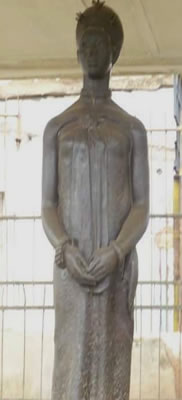
The statue of the stately woman, clad in the traditional wrapper and a headgear associated with the Benin royalty stands opposite the Oba market in Benin City. The statue was erected in honor of Emotan a patriotic woman who traded in foodstuffs at the very spot where the statue stands in the 15th century. At that period,{11th} Oba Uwaifiokun {1430AD-1440AD} usurped the throne of the Benin kingdom in place of his senior brother, Prince Ogun who was the heir apparent. Ogun in those times of travail. paid secret and nocturnal visits to Benin from his exile. On many occasions,this market woman called Emotan warmed Ogun of impending dangers and advised him against interacting with some treacherous chiefs who may reveal his presence. On one occasion Emotan actually hide prince ogun from his adversary.
When Prince Ogun eventually regained the throne and was subsequently crowned as the real Oba of Benin, he took the name {12th} Oba Ewuare the great {1440AD-1473AD}. He did not forget the pivotal role
|
played by this simple market woman, Emotan who saved him from glaring dangers during his exile years. When Emotan died, Oba Ewuare ordered that the sacred Uruhe tree be planted at the very spot where Emotan used to display her goods in Oba market and decreed that thereafter, every person in Benin who is performing any ceremony of whatever must pay homage to Emotan.Thus to this day every citizen,including the Oba himself pays homage to Emotan.
During the reign of {33rd} Oba Osemwende {1816AD-1848AD} the commemorative tree fell and he replanted another Uruhe tree on the same spot.
In 1951, the British colonial administration officials injected the tree with poisonous chemicals and uprooted it. This action almost led to a violent mass reaction. After which the {37th} Oba Akenzua II {1933AD-1978AD} vehemently protested the destruction of the Emotan shrine. This had been there since the 15th century. Consequently, the colonialists acceded to the request for a replacement. A life-size statue was cast by Mr. J.A.Danfor in London from a clay Marquette modeled by Enomayo, professional brass caster from the Igun-Eronmwon.
The new Emotan statue was unveiled amidst pomp and pageantry by the Oba Benin, Akenzua ll on March 20, 1954.
|
|
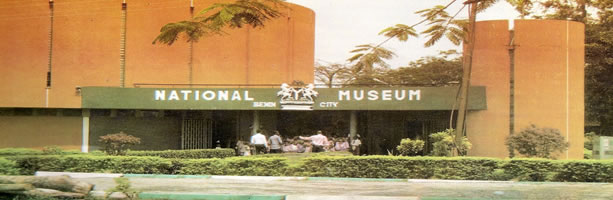
NATIONAL Museum of Benin City started from the Oba of Benin Palace in 1940 but the edifice we see today was officially opened to the public on August 10, 1973. The Museum contains priceless objects of antiquities from Benin Kingdom and other parts of the country. The first known Benin Museum started in the Oba’s Palace Benin .Traditional art was becoming famous and to preserve it, the Oba decided to assemble the artefacts under the custodian of Chief Jacob Eghareba within the palace in the Royal House- of Iwebo. As time went on, people developed more interest in these treasures. There was pressure mounted for these objects to be made public. This collection was relocated to one room in the old tax office Ring Road in Benin. This was later moved to the Benin Divisional Council because of space and through the efforts of one Mr. K.C Murray-a surveyor of antiquities and art teacher
In. 1960, the Federal Department now National Commission for Museums and Monuments took over the custodian of the artifacts. The National Commission for museums and monuments was established under Decree 77 of 1979. Since then, Museum has been growing
The edifices that house the artifacts today, situated on king's Square, Ring Road, Benin City was built during Samuel Ogbemudia regime as the two derma Military Government of Bendel State. This house with the exhibits therein was officially open to the general public in August 1973 with the ground and first floor galleries. While the second or unit gallery - was opened to the public in August 1996 through the efforts of Dr. O.J Eboreime as the Curator then.
The Museum contains artworks,artifacts and relics of the rich cultural history of the Bini people. A significant number of artifacts related to the Benin Empire such as terracotta, bronze figures and cast iron pieces. Tourists can take a visual excursion through the vareid collections and relish and re-live the artistic culture of the bini people.The Museum is arepository of the ancient,modern and contemporary artistic ingenuity,not only of the people of Edo state, but also of the major cultures of Nigeria.
The Museum houses three galleries. The ground floor houses the Oba Akenzua Gallery which contains artifacts from Benin City. The second floor houses some of the artifacts from within the city and those from neighbouring communities around the state and Delta State, while the second floor, known as the Unity Gallery, houses artifacts from around the country.
Among the artifacts at the Oba Akenzua Gallery is a bronze casting of the head of Queen Idia. The history of the Benin Kingdom cannot be completely told without extensive mention of Queen Idia. But for her doggedness, perseverance, patience and encouragement, the Kingdom would probably not be in existence today. Legend has it that the Benin Kingdom, then under the reign of Oba Esegie, was faced with the threat of war from the neighbouring tribe, the Ida's. Also a telegraphic stool sent to Oba Ovoramwen by his son. The story is told that the deposed Oba sent a message to his son requesting to know of the happenings in the kingdom. In reply, and for fear of the message falling into the hands of his father's captors, a telegraphic bronze stool was cast detailing danger, immorality, a new king and the presence of white men in the land.
Also domiciled in the museum is a bronze stool sent by a ruling Oba to the ruler of Portugal to beef up trade relations. The story goes that the Portuguese who didn't understand its importance made a replica sent it back to the reigning Oba, saying that his people are also versed in bronze casting. It is said that another stool was made and sent back to Portugal, this time with a more complex design. Door panels were designed then to tell the profession of the dwellers.
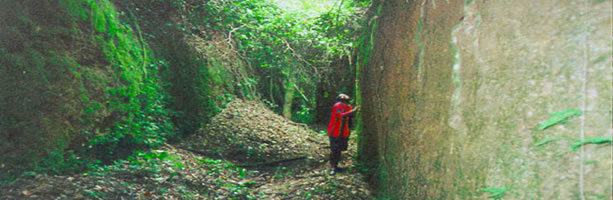
The Benin moat, also known traditionally as Iya,is the largest man-made earthworks in the world. One of the wonders of the world, it predates the use of modern earth-moving equipment or technology in these parts. The moat encircles the old perimeter precincts of the City and was constructed as a defensive barrier in times of war. {5th} Oba Oguola {about 1280-1295} dug the first and second moats to fortify the City from invaders; Udo warriors "Iyokuo" under the command of Chief Akpanigiakon a powerful war lord, and the ruler of Udo. Oba Oguola further decreed that important towns and Villages should build similar moats as defence systems around their communities. This gave rise to twenty of such moats around Benin City and its environs. Oba Oguola succeeded in crushing Chief Akpanigiakon and his powerful armies at the battle of Urhezen about 1285 CE. An extension of the moat was constructed in the 15th century during the reign of {12th} Oba Ewuare the Great (1440-1473 CE).The Benin moat is over 3200 kilometres long.
Chief Ogiamien Ancient Palace:
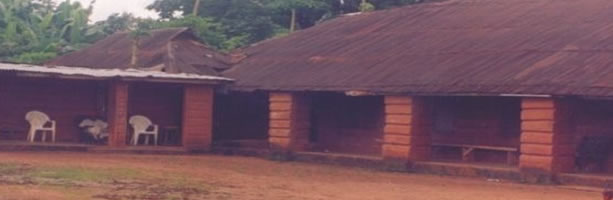
The chief Ogiamien Ancient Palace building is located at No. 97 Sokponba Road in Benin City. It is a National Monument situated within the city walls and Moat (another historical monument).Built about 1130AD with a great significant as the only building that predate the emergence of OBASHIP in Benin political Organization and the only building that survived the 1897 British expedition and siege. It was declared a National Monument in May 26th 1959 and by Decree 77 of 1979 that establish the Nationa Commission for Museum and monuments; and gazetted under the Federation of Nigeria official gazette No. 31 Vol. 46 of 1959, the protective cover of part II section 3 of the 1999 constitution of the Federal Republic of Nigeria under the concurrent legislative list.
The Chief Ogiamien historical building has survived the hash natural weather and human factors of deterioration till date. A rectangular shape of ancient design, fluted terecotta walls, presently covered by corrugated iron roofing sheets and nails, is a typical; unique traditional Benin architectural work.
The wall is a vertical undulating surface designed in relief. The front wall has two doors, the main entrance and the (Urho-Erinmwin) which is permanently blocked but open once during the coronation of the Oba of Benin Kingdom.
The building has about twenty rooms embedded in eight separate courtyards. A pitch roofing design constructed to provide an impulvia pattern, which is open to the sky to allow ventilation, sunlight, moonlight and rainfall into the courtyards.
Ogiamien personal, family and community shrine and altars are also located within the courtyard and other parts of the building. The floor of each courtyard is designed to provide a sunken level which aid water collection into an underground interconnected drainage system. The building has large open kitchen used for the preparation of chief Ogiamien food and an Egun, graveyard where all past Ogiamien were buried.
CULTURAL/RELIGIOUS SIGNIFICANT OF OGIAMIEN ANCIENT BUILDING.
The Ogiamien Ancient palace building have several cultural/Religious significant, foremost among which is the role it plays in the event of the coronation of the Oba of Benin (HOW?). The building is patterned for cultural residential house of a light placed and reputable Chief (Evian - the builder for His son Ogiamien).
An administrative building where He (Evian) rule and gave regulations guiding the entire Benin kingdom;
He receives visitors and entertain stranger, even accommodate them when necessary.
Slaves, captives of war are kept in their apartment within the building.
A traditional healing chamber is built in one of the courtyard as centre for administering healing for both spiritual and physical illness and attack.
It’s equally a spiritual consultation centre where oracles, rituals, sacrifices and divination and other form of worship take place.
It’s a traditional court room where dispute are settled for family and the entire Benin kingdom.
Is a centre for entertainment even today various forms of cultural dances, songs, folktales and stories take place in the building.
Chief Ogiamien celebrates Igue festival a day before the Benin general Igue festival then making his home a centre of ceremony.
A section of the palace serves as graveyard for the burial of all past Ogiamien except the first Ogiamien who was buried in his bed-room,
Within area of the grave-yard is a place used for pronouncing curses by young girls who were defiled by men (Ake shrine).
TABOOS IN THE OGIAMIEN ANCIENT BUILDING
The (Urho Erinmwin) second entrance door is sacred and exclusively used by the Oba of Benin as a passage way into the building as well as an exit. The door is barricaded and any body that violate this norm would face the wretch of death.
Chief Ogiamien wives do take oath of loyalty at the primordial tree Olode Ikhimwin tree, located in the building. And the most junior wife, whose duty is to cook, must be naked by custom to avoid any evil intention.
He has a personal temple where his personnel items and regalia are kept. He equally isolates himself when preparing for war or after returning from war in this temple.
IMPORTANCE
Specifically, Chief Ogiamien ancient edifice provides an avenue for cultural display, film production, family meeting place and a point where poems, idioms are recited. Folksongs such as lullaby and story-telling (folktales) take place. These act as synthesis that condition social life.
The monument has enormous cultural tourist potentials which can fetch revenue for the local community, family and government in general, if properly harnessed, packaged and marketed.
Is a focal point in Benin History and architectural design, hence it serves as education and research centre for cultural bodies and student all over the world.
In general, the importance of our Heritage cannot be overemphasised. The greatness or pride of a Nation is tied to the wealth of their heritage. Thus conveys a testimony of the people daily life, to express their creative capacity and present the traces of their History.
As a receptive or package of memory, it embodies the symbolic of cultural identities and constitute fundamental references for structuring society. Heritage allows every human being the opportunity of self discovery.
It is useful in binding social groups together and bringing cultural communities closer to one another.
Heritage is an instrument of third way process between past, present and future.
Aro Edion Edo Shrine
THE ARO EDION EDO
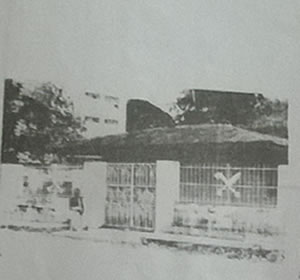
Is the Shrine dedicated to the Spirits of the collective dead of Benin City. It is situated at the approaches to the Urbo Okperhe the main public entrance to the Benin Palace It now shares with the elevated Water Tank in front of the Palace the intervening piece of land which separates the Oredo Local Government Secretariat building from the Palace groundsThe little building which houses the Shrine is well constructed with modern durable materials of sandcrete blocks and correlated iron roofing sheets the walls are fluted, like those of the Palace adjacent, denoting that it is a building of traditional importance. On the walls, and also on the railings of the perimeter fence are depicted the artefacts of the symbols of royalty and authority in Benin land, the State Swords of the ADA and the EBEN, done in iron.
The little building has only one door. Inside the building is an altar on a raised dais, on which stands the stave the Ukhurhe, which represents the collective dead of the City. These multitudinous dead, citizens who have lived in, and cared for, this town for over a thousand years are exhorted, invoked and propitiated through the wooden stave, the UKHURHE EDION, which represents their collective presence.
The ESOBAN of Benin is the ODIONWERE of the City, and therefore the Priest of the Aro Edion Edo.He alone officiates at the Shrine, at the behest of the Oba of Benin.
When the Esogban dies the Ukhurhe, the stave at alter, is made to lie horizontally until another Esogban is appointed by the Oba. When the City has her new Odionwere the Ukhurhe, is stood upright again and so remains until another Esogban transition occurs.
The Aro Edion Edo has always been in occupation of its present location for as long as human memory can recall. There is oral evidence to suggest that Oba EWEDO was not the first Benin monarch to occupy the present site of the Benin palace. The site was said to have been first occupied by the palace of later OGISOS of the first Dynasty. The last occupant was Ogiso OWODO who lived at the beginning of now dying Second Christian Millennium, about a thousand years ago. When that line of kings died out the palace became derelict and was taken over by bush. It ultimately disappeared and the area became known as:
Ogbe Ogiso n’ Uzamokon
Later it was also referred to as: Ogbe Ogiso n’ Oghionba during the early decades the Obaship dynasty. The huge drum Agba with which those Ogisos of old summoned towns meetings was said to have been sited where Oba EWEDO later built his IKOHAE, the temporary abode which sheltered him when the first arrived in Benin Urban, fresh from his suburban USAMA palace. It was while living in the IKOHAE that the young king tackled the arduous task of building himself a palace in the grounds of the cemetery that the Ogbe Ogiso had meantime became. The location of the Ogiso’s Agba drum, and later of Oba EWEDO’s IKOHAE is near where the URHOKPOTA Hall now stands. The Edion Edo Shrine was, even at that time probably already where it occupies today, at the approaches to the palace.
The Edion Edo Shrine is the first Station in the Processional Route of Honour, the Pilgrimage through the City, which the new Chief has to make as the chore in the long process involved in the validation of his title. The Chief comes out in procession from the palace where the Oba, seated on the Throne had already received his thanksgiving. He walks forward a short distance and then turns lift to the Aro Edion Edo.
In front of the Aro Edion Edo the Chief disengages his arms from the supporting hands of his ENOBORE, his Arm-Supporters, and takes the EBEN, the Junior Sword-of-State, possessed by all Chiefs, from his Eben-Bearer. He trills the sword four times, in thanksgiving and in self-identification, to the Spirits of the collective dead of the land. He hands the EBEN back to the Eben-Bearer, and re-surrenders his arms to his two arm-supporters. With the drums egging him on, and the stirring songs of the chorus women remaining him of the historical past, the nobleman comes fully into the realisation of who he truly his yet another link in the unbroken chain of the long history of the ancient land. With quickened and lightened step he departs the presence of the collective dead, and strides out on his long pilgrimage through the streets of Benin.
The celebrants might have been conferred with the senior title of an EGHAEVBO. This honour entitles him to share with the Oba of Benin the possession of the two swords of authority in Benin land, the ADA and the Eben. These two swords have been emblems of authority in Benin for one and a half thousand years .They were inherited by the Obas from the Ogiso monarchs.
The ADA is the superior emblem, and it takes precedence, wherever it appears, over the EBEN. All chiefs are invested with the authority to possess the EBEN. But it is only a number of them who are additionally conferred with the right to possess the ADA. Titles which have this right are called EGIE ADA. In old Benin an Enogie or Ovie (in Urhobo-land) could not order the execution of any of his subjects unless the right to possess The ADA had been conferred on him by the Oba of Benin.
The EGIE ADA Chiefs of the OGISO era notably the UZAMA nobles: the Oliha, the Edohen, the Ero, the Eholor n’ ire, hoisted their ADA as they made their way through the streets of Benin to OGISO palace, and later with the change of dynasty, to the Oba palace at USAMA. But some seven hundred and fifty years ago when Oba Ewedo came to the throne and moved from USAMA to the Ogbe Ogiso n’ Uzamokan, the present Benin Palace site he engineered the loss of their right by the Egie Ada Chiefs. Since that time no other Ada has remained aloft in the presence of the Oba of Benin and his own lofted Ada.
The Ekponmwen Orere Pilgrimage round the City by the new Chief provides the only opportunity nowadays when the Egie Ada Chiefs able to go round the town with his Ada held aloft before him. He leaves his home that morning decked in all the perquisites with which t he title has been endowed, including his Ada and Eben Swords of authority, held aloft by attendants
But even on this special day the Chief’s lofted Ada does not get into the Oba Palace rounds Only the Eben does. At the approach to the Palace, and by the ARO EDION EDO the chiefs OMADA, the Ada-Bearer, would drop out of the procession and wait patiently by the Shrine until picked up again by the concourse returning from the Palace. Thereafter the Ada was held aloft before the Chief, until the completion of the Pilgrimage, and the celebrant arrived back at his home The Ada would henceforth feature only in the ceremonies which took place within the premises of the chief.
All ennobled citizens pay obeisance with Eben at the Aro Edion Edo when in procession to and from the Palace the OGIEFA NOMUEKPO is the only chief who does not do honour to, or offer worship at the Shrine. This is because of what happened some five hundred and fifty years ago.
OGUN later Oba EWUARE was a fugitive Prince with his life forfeited if caught He sought and obtained refuge in the Forestry Road premises of Chief Ogiefa Nomuekpo. Helped by his slave called EDO the Ogiefa hid Prince OGUN in the depths of a dry well in the premises.
EDO helped OGUN to escape when the bondsman discovered that his lord the Ogiefa, under great pressure, had yielded the secret of Ogun’s hiding place to his fellow chiefs. For this gross act of insubordinate the Ogiefa punished the bondsman by hanging him near the spot through where the IYAERO Moat was later dug by Oba Ewuare
When Ogun became the Oba he purchased Edo’s remains from Chief Ogiefa Then he exhumed whatever was left of the remains and gave the slave his freedom posthumously. He had the remains buried underneath the altar of the Ukhurhe Edion, at the Aro Edion Edo. He invited the people to join him in honouring this bondsman who lost his life in order that he, Ewuare might live.
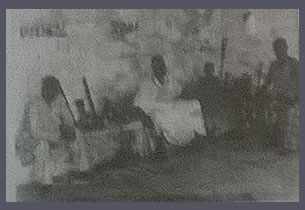
The main Ekpenede Shrine
THE ARO EKPENEDE
The New chief leaves the Aro Edion Edo in procession. Arrives at IWEBO Street and turns right, towards the ARO EKPENEDE, the second Station in the Pilgrimage route
The Aro Ekpenede, the Ekpenede Shrine, is in two locations, doubled as it were. The portion of it which is first encountered by the celebrant, and which is only about a hundred metres from the Aro Edion Edo, receives only an acknowledgement of a twirl or two of the Eben from the celebrant when he draws opposite it. The second portion, to be encountered later, and situated along Ekpenede Street constitutes the main Ekpenede Shrine. It is at this second portion that the new Chief will present his propitiation gifts and receive the recognition and the prayers of the keepers of the Shrine.
At neither of the two Ekpenede’s Shrines is drumming permitted in the procession accompanying the newly ennobled citizen. The women-forks take over the music making and their Ukuse, the native castanets, alone provide the instrumental accompaniment to the sung melodies.
This proper at this stage to tell the story of the man in whose honour the doubled Shrine has been created >>Full Story
|
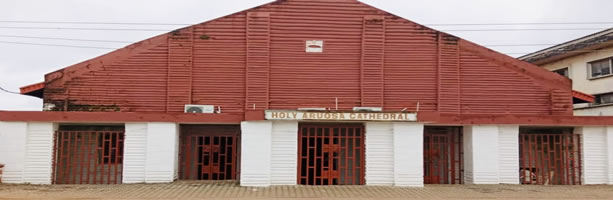 Holy Aruosa Cathedral: Holy Aruosa Cathedral:
{Aruosa N'Akpakpava}
Is the oldest church in Nigeria .Build in the 15th century situated in Akpakpava Street in the ancient city of Benin. Aruosa {Church of Benin} is the Benins version of Church of England or the Dutch reformed church. The Portuguese brought Christianity to the imperial Benin kingdom in the
in which are Aruosa N'Akpakpava, Aruosa N'Idunwuerie and Aruosa N' Ogbelaka all in Benin City. During the Idah war of 1515-1516 the Portuguese missionaries accompanied Oba Esigie to the battle fields. Oba Esigie could read and write Portuguese fluently. The Benin Monarch is the head of the church, the priests called Ohen-Osa are responsible to him .The pattern of worship is a mixture of indigenous beliefs and Roman Catholic practices.
|
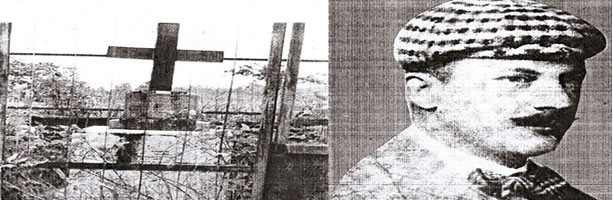
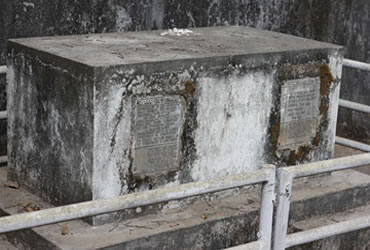
The tombstone of Captain James Phillip located at Uruokhokho in Ovia North East Local Government Area of Edo state, attracts historians , students, researchers and visitors from across the world all year round. It marks the spot where Captain Phillip and his party on a trade mission to Benin in January 1897 were killed and buried .The event is generally referred to as the Benin massacre which led to the invasion of Benin and the eventual deportation of Oba Ovonramwen to Calabar were he died on the month of January 1914 after sixteen years of British captivity.
|
|
Ughoton:
Ughoton village, about 42 kilometers from Benin City, historically very important. According to historians a Benins, Prince Ekaladerhan {Izoduwa} later known to the Yoruba as Oduduwa was banished with his mother from the City of Benin to Ughoton. One of the darkest event in the history of the Benins, from there he took the painful and joyful journey from the land of Benin that eventually took him to Ile-Ife. For full story, see the correct history of Benin. An Ideal place for historians, researchers, academicians, students and visitors alike. The shrine of the Olokun priest who was sent to portugal By Oba Esigie {About1504-1550AD} to understudy christianity and report back to the imperial Benin kingdom is also situated in Ughoton.
|
|
Gelegele Fountains & Historical Port of Benin Site:
then onward used predominantly for their legitimate trade with Benin The first contact with any European was made by Oba Ewuare the Great {About 1440AD} when Ruy De Sequeira vivited Benin City In 1472. The Portuguese came via the Atlantic Ocean and they finally landed in Gele Gele Sea Port in Benin Nation. The Gele Gele Sea Port was from Nation.It is also record that slaves (illegitimate trade) were also conveyed from the region via the Gele Gele Sea Port to Europe. Factually the Portuguese and British Government used the Gele Gele Sea Port extensively for more than half a century before the 1897 infamous British punitive expedition. This historic Sea Port site is today part of Benin kingdom historical sites.
|
Statue of the Giant Arhuanran Of Udo:
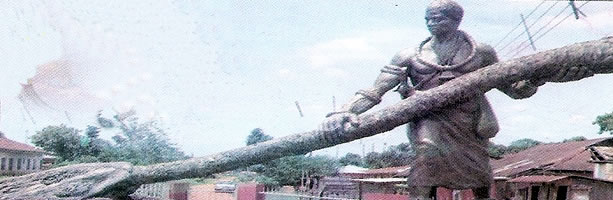
This giant statue was sculptured to the memory of Arhuanran{Goliath type stature}a very powerful warrior and ruler of Udo. Oba Esigie {About 1504-1550AD} ascended the Benin throne at the peak of a war threat from Udo. Esigie in Benin City and Arhuanran in the town of Udo, about 20 miles from Benin City to the northwest. Udo then, was an important centre almost as large and powerful as Benin City. His brother Arhuanran who was tricked fromascending the Benin throne due to palace intrigues, decided to go intobattle with the new Oba. The battle was fought and won by Oba Esigie. Arhuanran drowned himself in Lake Odighi N’Udo.
Chief Osemwughe the Iyase of Udo took arm again against the monarchical authority to avenge the defeat and the death of Arhuanran his master cut the victory celebration short.
Oba Esigie launch a war on Udo once again .Udo was destroyed chief Osemwughe and his rebel armies fled. West of Benin kingdom now part of Yoruba land.
Oba Esigie determines to put an end to Udo rebellion once and for all. Sent royal troops under the command of Odobo and Aile to pursue them in the process the Benins royal army builds military camps {Eko} along the way some of these camps {Eko} are now towns in Yoruba land.
Some of the Camps are camp Odobo {Eko-Odobo} name after general Odobo contracted into Akotogbo and camp Ikalo {Eko-Aile}name after general Aile was contracted to Ikale.
Osemwughe and his militants gave themselves up; when they could not face the war machines of the Benins royal troops much longer.
They were later given a royal pardons by Oba Esigie but decided not to return to Udo .Chief Osemwughe and his party were called Emma N’ Udo{the Udo deserters} which was later contracted to Ondo and the leader of the militants Chief Osemwughe was mispronounced Osemawe a title by which all Ondo monarchs are now known.
|
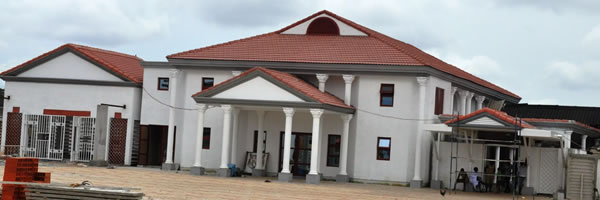
The first storey-building in Benin Kingdom, built in 1906, by High Chief Osawe Iyamu, the then Inne of Benin. Widely regarded was the second oldest story-building in Nigeria after the first one at Badagry, Lagos built in 1845 by white missionaries. Egedege N' Okaro is Situated at House No 30, Erie Street,off Sakponba Road,in ancient city of Benin.
According to historical accounts, Egedege N’Okarowas the first residential one-storey structure to be built in the ancient city. It is made of red furnace-fired bricks with wooden decking. The design of building was given to Chief Iyamu by a Briton, Mr. Crawe Reade, a colonial officer who supervised its construction. A similar structure used as a ware-house was built by the Dutch in 1720 at Ughoton, a sea port. It was destroyed in 1767 by the French, according to historical accounts.
Although it was said that Chief Iyamu was not the first to start the construction of a storey-building, he completed his first. After his came the two, owned by the late Chief Eson Orokhiri and Prince Usuanlele Ovonramwem, on Ibiwe Street in Benin.
Interestingly, Egedege N’Okaro is a representation of the period in which it was built. The British had come with new things, ideas and new inventions were coming in.
More than hundred years old, the structure still stands firmly and majestically.
What then is the secret behind the sturdiness of Egedege okaro over the years? Certainly, its builders were skilled masons who had their acts well articulated and executed with competence, thus ensuring the durability of the building.
The bricks of red earth used to build the structure were fired for three months and cooled for two weeks in the valley in the present Ikpoba Slope in Benin city. Its wooden decking and roofing were made of timber from choice trees Mahogany and Iroko of about hundreds of years.
The signboard with the inscription: the Centenary Celebration of Egedege N’Okaro (the first storey-building in Benin Kingdom) advertising its uniqueness alongside the address of the place cannot be missed by any passers-by. The wall fencing has Benin traditional designs. On closer examination, Egedege N’Okaro has an oriental appeal. By the porch on the ground floor are six huge roman columns painted red with some artistic designs. At the main entrance into the building with two wooden carved doors is a flower decoration. It has arch-shaped windows which delineates the oriental feel.
(Urhonigbe)The Birth Place Of Olokun
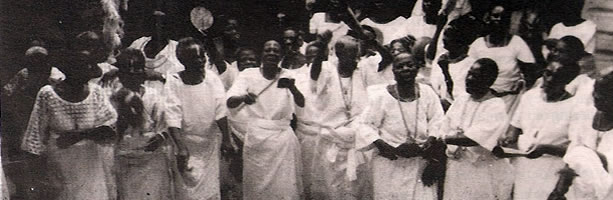
It so happened that at this time a hunter from the town of Urhonigbe, which I like to refer to as the “Mecca” or holy land of Olokun, went into the forest to hunt. He went as far as to the vicinity of the source of Ethiope River Suddenly; he heard the sound of melodious singing and dancing. Surprised, he stopped to look around but he saw nothing. He wanted to run away but could not. At the instance of a voice, he looked straight in front of him and, to his surprise, he saw what looked like a King surrounded by his courtiers. Olokun and his courtiers have become materialized for the purpose of disclosure. The hunter was invited to join the group and share in me ceremony which was to be his experience for the next three years in the course of this period the hunter was taught something of the person and the nature of Olokun, his mission on earth, the rituals and dancing necessary for the proper worship of Olokun.
In the meantime, the hunter’s family and the people of Urhonigbe town started to search for him. After searching in vain for a long time they gave him up as dead, Three years later, after everybody had forgotten the incident, the hunter emerged from the bush. He came out dumb and carrying, on his head a pot of water. He started to dance around the town. As he continued his dance people who were first scared of him eventually followed him even though he was unable to talk to them. Before long, people got caught up in this pantomimic dance. Until this day, as a re-enactment of the hunter’s emergence in this condition, the annual festival is heralded by a pantomimic dance known as ekaba in Edo.
Fourteen days after he re-appeared, the hunter started to talk again! Consequently, he was able to relate his spiritual experiences to the people. Among other things he told them how he has been appointed as the arch-priest of Olokun in Edo kingdoms while the town of Urhonigbe has been chosen as the seat of the Olokun worship. At first, people were sceptical about his story but in no time they became convinced as those who went to him for various spiritual and material blessings received them.
The site on which Olokun temple stands today is believed to be the very spot on which the hunter placed his ceremonial Olokun—pot after fourteen days of nonstop dance following his return from the spirit world of Olokun. The two-chamber-temple which was once at the southern edge of the town is now almost in the centre of the town because of the growth of the town. It still, however, has a little grove behind it. The first chamber contains the statues of Olokun and his chiefs by whom he is surrounded. Standing by the door, as you enter, is a statue of a soldier that looks very much like the statues of Portuguese soldiers who were in Benin in the 16th to 17th centuries. The second chamber is the harem for Olokun’s wives. This is filled with images of Olokun’s wives. As the headquarters of Olokun cult the annual festival must first be celebrated here before the priestesses, scattered all over the State, can have theirs. Infect, all of them are expected to participate in this one as a prelude to their separate observance at their respective shines.
 |
Asoro Statue:
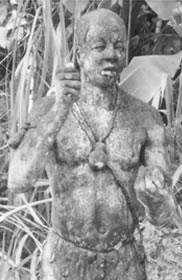
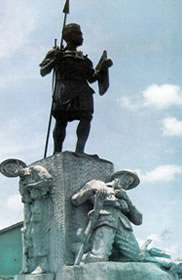
This almost life-like statue was sculptured to the memory of Chief Asoro, a valiant brave man who died resisting the invading British forces during the expedition of 1897. During the siege on Benin, it was said that chief Asoro ably defended the spot where the statue now stands. He said "no other person dare pass this road unless the Oba" (So kpon Oba). It is this statement which has been corrupted to become SAKPONBA.The present Sokponba village and Sakponba Road derive their names from Chief Asoro's statement. This statue, which is a salute to Patriotism and loyalty is located on the king's Square by the beginning of Sokponba Road, Benin City the spot where chief Asoro have died after fighting bravely.
|
|
|
|
|
|
|